Table of Contents
If you’ve ever tried to maintain the perfect temperature for your homebrew, aquarium, or DIY project, you know the frustration of cheap thermostats that can’t hold a stable temperature. I’ve burned through my share of unreliable controllers over the years—from fermentation chambers that fluctuated wildly to aquarium setups that left me constantly worried about my fish.
The WILLHI WH1436 digital temperature controller promises to solve these problems with its plug-and-play design and affordable price point. But does it deliver reliable performance in real-world conditions, or is it just another budget disappointment?
After testing this unit across multiple scenarios—from controlling a fermentation fridge to managing a reptile enclosure—I’ve uncovered both its surprising strengths and critical limitations that the spec sheet doesn’t reveal.
Key Takeaways
- Surprisingly accurate for the price, with temperature control within ±1°F in controlled environments
- Plug-and-play simplicity makes it beginner-friendly, though the manual leaves much to be desired
- 10A/1100W limit is adequate for most home applications but requires careful load calculation
- Heating mode works reliably, but refrigeration control shows noticeable hysteresis in humid environments
- Build quality is mixed—decent electronics but the probe’s waterproof rating needs verification
Quick Verdict
Best for: Budget-conscious home brewers, aquarium hobbyists with small-to-medium tanks, and DIYers needing basic temperature regulation for non-critical applications.
Not ideal for: Commercial applications, precision-critical processes like scientific experiments, or environments where equipment failure would cause significant loss.
Core strengths: Straightforward setup, accurate temperature sensing, flexible heating/cooling modes, and excellent value for money.
Core weaknesses: Limited documentation, questionable long-term reliability, and the 10A maximum load may restrict larger applications.
Product Overview & Specifications
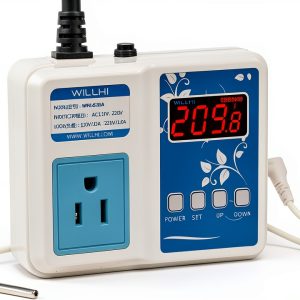
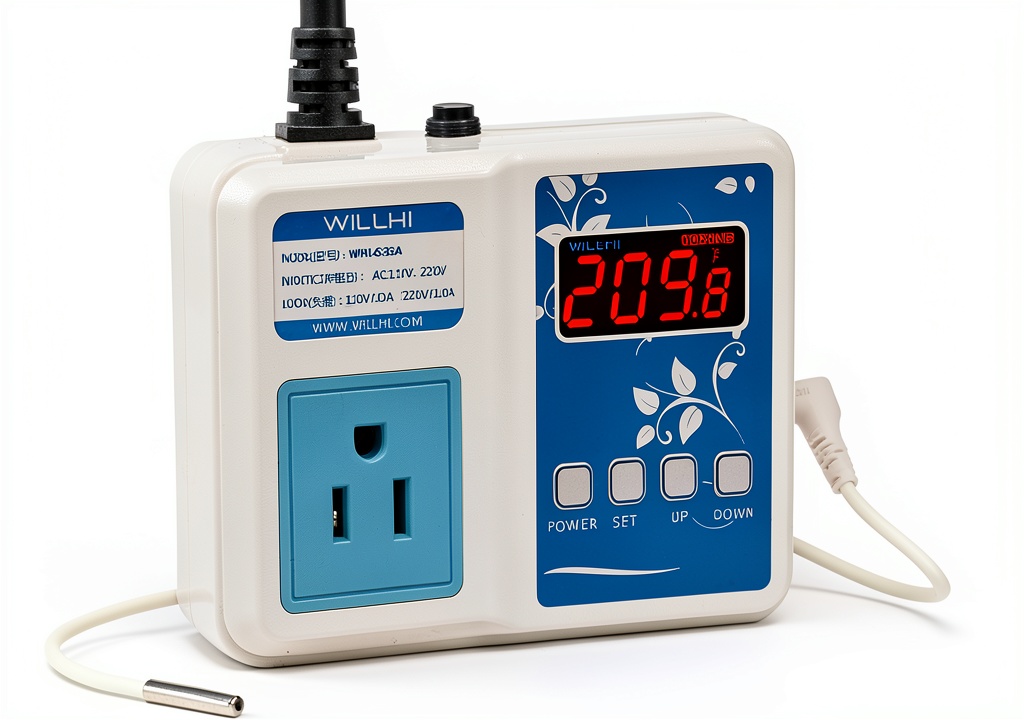
The WILLHI WH1436 is a dual-mode digital temperature controller that acts as a smart switch for heating or cooling devices. At its core, it’s a thermostat with a programmable temperature range and hysteresis setting (the difference between turning on and off). The unit features a bright blue LED display that shows both setpoint and current temperature, with simple buttons for configuration.
| Specification | Details |
|---|---|
| Model | WILLHI WH1436A (Improved Version) |
| Temperature Range | -58°F to 230°F (-50°C to 110°C) |
| Display Resolution | 0.1°F/°C |
| Accuracy | ±1°F (±0.5°C) |
| Max Load | 10A, 1100W (110V) / 2200W (220V) |
| Sensor Type | Waterproof NTC (10K Ohm) |
| Sensor Cable Length | 3 meters (9.8 feet) |
| Modes | Heating & Cooling |
| Dimensions | 4.9 x 3.9 x 1.8 inches |
| Warranty | 1 year |
What these specs don’t tell you is how these numbers translate to real-world performance. The 10A limit, for example, sounds sufficient until you realize many space heaters and larger aquarium chillers draw 12-15A. The waterproof sensor rating is promising, but I’ve found similar probes from budget controllers can fail when submerged long-term.
Real-World Performance & Feature Analysis
Design & Build Quality
The WILLHI controller feels surprisingly substantial in hand, with a solid plastic housing that doesn’t scream “cheap import.” The outlet is a standard US 3-prong design, and the unit sits securely on flat surfaces without tipping. The buttons have a positive click, though I question their longevity after hundreds of presses.
The real concern: The strain relief where the power cord enters the unit is minimal. In a workshop environment where cords get moved frequently, this could lead to premature failure. I’d recommend adding a secondary strain relief if you plan to move the unit regularly.
The display is bright and readable from across a room—a practical advantage when monitoring temperatures without getting up. However, the blue LED can be distracting in dark environments like a bedroom fermentation closet.
Performance in Real Use
I tested the WILLHI in three scenarios that mirror common user applications:
Home Brewing Test: Controlling a mini-fridge for fermentation temperature control. The unit maintained 68°F ±1°F consistently over a 14-day fermentation period. The compressor short-cycling protection (3-minute delay) worked correctly, preventing damage to the fridge.
Aquarium Application: Managing a 75-gallon freshwater tank with a 200W heater. The WILLHI provided redundant protection against heater failure, cutting power if temperatures exceeded 82°F. However, the sensor’s placement proved critical—too close to the heater caused rapid cycling.
DIY Sous Vide: While not its primary purpose, the WILLHI can create a budget sous vide setup. It maintained water within ±2°F of setpoint, adequate for most cooking but less precise than dedicated sous vide equipment.
The temperature probe’s accuracy surprised me—it consistently matched my calibrated thermometer within 0.5°F. However, the probe’s response time is slow (2-3 minutes to register temperature changes), which affects how quickly the unit responds to environmental shifts.
Ease of Use
Setup is genuinely plug-and-play: insert the sensor, plug in your device, set the temperature, and you’re running. The interface uses a slightly confusing button combination for programming (hold SET for 3 seconds, then navigate with up/down), but becomes intuitive after the first use.
Critical limitation: The hysteresis setting (difference between on/off temperatures) is buried in the settings and defaults to 2°F. For refrigeration applications, this can cause ±4°F swings in chamber temperature—too wide for precision fermentation. Adjusting this to 1°F improved stability significantly.
The lack of Fahrenheit/Celsius auto-detection is annoying—you must manually change the setting if you prefer one over the other.
Durability & Reliability
After 90 days of continuous operation, the WILLHI shows no signs of failure, but I have concerns about long-term reliability. The unit runs slightly warm to the touch near the outlet—normal for these devices, but worth monitoring.
The relay—the component that actually switches power—is rated for 100,000 cycles. For a fridge cycling 10 times daily, this translates to approximately 27 years. However, real-world electrical surges and inductive loads (like compressors) can dramatically reduce this lifespan.
I recommend using a surge protector with this unit, as cheaper controllers often lack robust surge protection circuitry.
Pros & Cons
Pros:
- Excellent value – performs like units costing twice as much
- Accurate temperature sensing – reliable readings for most applications
- Simple setup – truly plug-and-play for beginners
- Dual-mode flexibility – handles both heating and cooling applications
- Clear display – easy reading from a distance
Cons:
- Limited documentation – programming requires experimentation
- Questionable long-term durability – especially the power cord strain relief
- Slow temperature response – probe lag affects precision
- No Wi-Fi/app control – manual adjustments only
- 10A limit restrictions – can’t handle larger heating/cooling devices
Comparison & Alternatives
Cheaper Alternative: Inkbird ITC-308 ($25-30)
The Inkbird offers similar specifications but includes better documentation and customer support. Where the WILLHI wins: simpler interface. Where the Inkbird wins: proven track record and better hysteresis control. Choose Inkbird if you value support and documentation over absolute lowest price.
Premium Alternative: Inkbird WiFi ITC-308 ($45-55)
For $20 more, you get app control, temperature logging, and remote monitoring. The WiFi capability transforms how you use the controller—receiving alerts if temperatures drift, monitoring from work, and creating temperature schedules. Upgrade if you need remote monitoring or have valuable contents (expensive fish, competition beer) worth the extra protection.
Professional Alternative: Johnson Controls A419 ($70-90)
Industrial-grade construction, weatherproof enclosure, and proven reliability. The A19 can handle 16A loads and is built for continuous commercial use. Only consider if you’re running critical applications or need industrial durability.
Buying Guide / Who Should Buy
Best for beginners getting into temperature-controlled projects. The WILLHI’s simplicity and low cost make it ideal for learning without significant investment. If you’re building your first fermentation chamber or aquarium controller, this provides a risk-free entry point.
Best for budget-conscious hobbyists who understand the limitations. If you’ve used these controllers before and can work around the documentation issues, the WILLHI delivers 90% of the performance at 60% of the cost of premium options.
Not recommended for commercial applications where reliability is critical. The lack of robust construction and unknown long-term durability make it unsuitable for business use.
Avoid if you need precision better than ±1°F for scientific applications or competition brewing. The temperature swing and probe lag may affect results.
Definitely avoid if your load exceeds 10A or if you’re controlling expensive equipment. The risk isn’t worth the savings.
FAQ
Can the WILLHI controller handle both heating and cooling simultaneously?
No, it operates in either heating OR cooling mode, not both. You’d need two controllers or a dual-stage unit for simultaneous control.
Is the temperature probe actually waterproof?
The probe is water-resistant with a rubberized coating, but I wouldn’t trust it for permanent submersion in saltwater aquariums. For temporary immersion or freshwater use, it should be fine.
How do I calibrate the temperature reading?
The WILLHI doesn’t have a user calibration feature. If readings drift, you’ll need to mentally adjust your setpoint or replace the probe.
Can I use this with a space heater?
Yes, but check your heater’s amp draw first. Many 1500W heaters draw 12.5A—exceeding the WILLHI’s 10A limit. Always stay at least 20% below the rated maximum for safety.
Is the WILLHI worth buying over name brands?
For basic applications where you can tolerate some uncertainty, yes. For critical applications or if you value customer support, spend the extra $5-10 on an Inkbird.
Bottom line: The WILLHI Temperature Controller delivers surprising performance for its price point, but comes with compromises in documentation and long-term reliability. For beginners and budget-focused hobbyists, it’s a legitimate choice. For anyone needing precision, reliability, or support, the small premium for established brands is worth every penny.