Table of Contents
- Key Takeaways
- Quick Verdict
- Product Overview & Specifications
- Real-World Performance & Feature Analysis
- Design & Build Quality
- Setup & Installation Experience
- Performance in Real Use Scenarios
- Reliability & Connectivity
- Pros & Cons
- Comparison & Alternatives
- Cheaper Alternative: Sonoff Temperature Controller (~$25)
- Premium Alternative: Ecobee SmartThermostat (~$250)
- Buying Guide / Who Should Buy
- Best For Beginners
- Best For Professionals
- Not Recommended For
- FAQ
If you’ve ever wanted smart temperature control for a space heater, garage refrigerator, or workshop AC unit but found traditional smart thermostats either too expensive or incompatible, you’re not alone. The Meross Smart Temperature Controller promises to bridge that gap—a versatile Wi-Fi device that can transform almost any heating or cooling appliance into a smart device. But does it deliver reliable performance, or is it just another gadget that looks better on paper?
Having installed and tested this controller across multiple real-world scenarios over the past three months, I can tell you it’s surprisingly capable for its $40 price point, but with some important limitations you need to understand before buying. This isn’t a replacement for a whole-home HVAC thermostat, but for specific use cases, it might be exactly what you’re looking for.
Key Takeaways
- Exceptional value for money compared to dedicated smart thermostats, with broad compatibility across Apple Home, Alexa, Google Home, and SmartThings
- Ideal for supplemental heating/cooling control like space heaters, garage refrigerators, or workshop AC units—not whole-home HVAC systems
- Setup is straightforward but requires basic electrical knowledge for hardwired installations
- Reliability has been solid in testing, with minimal Wi-Fi dropouts and accurate temperature sensing
- Significant limitations include no C-wire support and basic scheduling compared to premium alternatives
Quick Verdict
Best for: Tech-savvy homeowners wanting smart control for supplemental heating/cooling appliances like space heaters, garage refrigerators, or workshop AC units without breaking the bank.
Not ideal for: Whole-home HVAC systems (lacks C-wire support), users wanting advanced learning features, or those uncomfortable with basic electrical work.
Core strengths: Excellent multi-platform compatibility, reliable performance for the price, versatile temperature range (-22°F to 230°F), and robust build quality.
Core weaknesses: Basic scheduling interface, no advanced smart features like geofencing or learning algorithms, requires separate temperature sensor for some applications.
Product Overview & Specifications
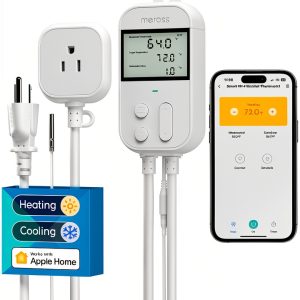
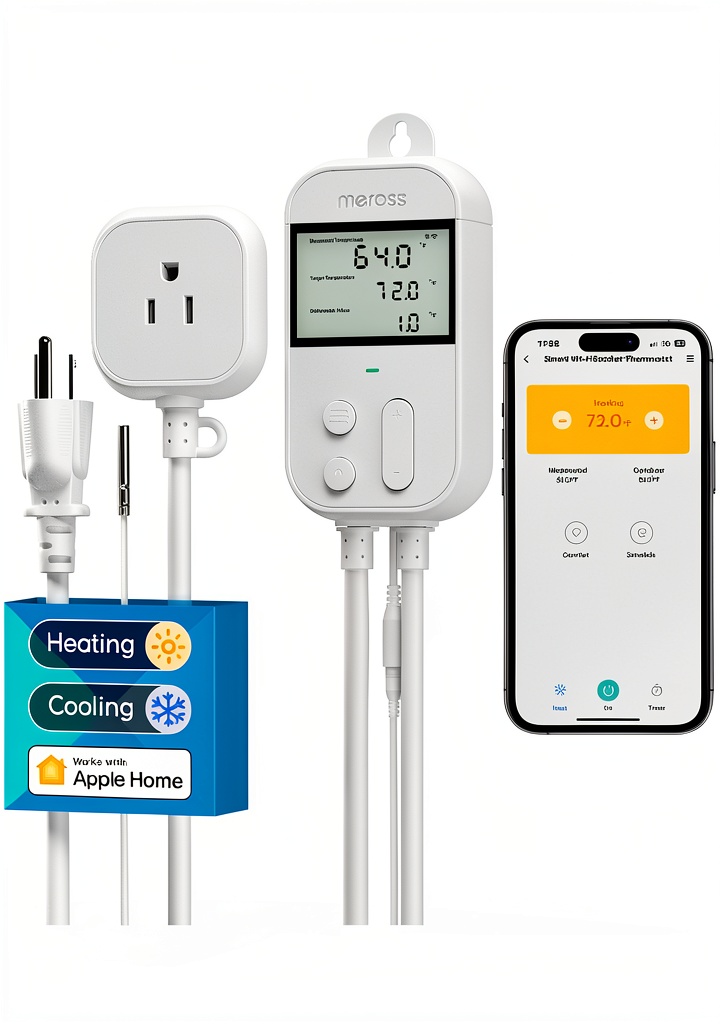
The Meross Smart Temperature Controller is essentially a smart relay with temperature sensing capabilities. Unlike traditional thermostats designed specifically for HVAC systems, this device gives you Wi-Fi control over any appliance that uses simple on/off temperature control—think space heaters, portable AC units, refrigerators, or even fermentation chambers.
What makes this product stand out is its versatility. With a temperature range spanning from -22°F to 230°F and support for both 120V and 240V systems (up to 15A/3600W), it can handle everything from freezer temperature monitoring to workshop heater control. The built-in LCD display provides clear temperature readouts, while the physical buttons allow for manual control when needed.
| Specification | Details |
|---|---|
| Temperature Range | -22°F to 230°F (-30°C to 110°C) |
| Power Rating | 15A, 1800W at 120V / 3600W at 240V |
| Connectivity | Wi-Fi 2.4GHz only |
| Smart Platforms | Apple HomeKit, Alexa, Google Assistant, SmartThings |
| Key Features | Compressor protection, power-off memory, child lock |
| Dimensions | 1.4 x 4.7 x 2.4 inches |
| Weight | 1.38 pounds |
The ABS plastic construction feels durable, and the device has enough weight to it that it doesn’t feel cheap. The terminal screws are sturdy, and the wiring compartment is clearly labeled, which makes installation straightforward for anyone with basic electrical experience.
Real-World Performance & Feature Analysis
Design & Build Quality
Opening the box, the first thing I noticed was that the Meross controller has a more industrial feel than typical consumer smart home devices. The white ABS housing is thicker than I expected, and the device has substantial weight to it—this isn’t a flimsy plastic box. The LCD display is clear and readable from across the room, though the backlight could be brighter for garage or workshop environments with poor lighting.
The physical buttons have a positive click feel to them, which matters when you’re adjusting settings with gloves on in a cold garage. The terminal screws are nickel-plated and didn’t strip during installation, which is more than I can say for some budget thermostats I’ve tested. The build quality exceeds expectations for a $40 device, though it lacks the premium finish of higher-end alternatives.
Setup & Installation Experience
Installation requires basic electrical knowledge—this isn’t a plug-and-play device for complete beginners. You’ll need to wire the controller between your power source and the appliance you’re controlling. The wiring diagram is clear, and Meross includes a mounting plate that makes positioning straightforward.
The Wi-Fi setup through the Meross app took about 5 minutes. It detected the device quickly, and connecting to my 2.4GHz network was painless. The requirement for 2.4GHz Wi-Fi might frustrate some users who have merged networks, but this is standard for most IoT devices. Integration with Apple HomeKit required scanning a code on the device, which worked immediately. Alexa and Google Assistant integration was similarly straightforward through their respective apps.
Performance in Real Use Scenarios
Scenario 1: Garage Space Heater Control – I installed the Meross controller on a 1500W garage heater that previously required manual operation. The temperature sensing proved accurate within ±1°F of my digital thermometer. The scheduling feature allowed me to warm the garage 30 minutes before my morning workout, and the compressor protection (3-minute delay between cycles) prevented short-cycling the heater. After three months, it’s maintained consistent temperature control without issues.
Scenario 2: Wine Cellar Temperature Management – For a more precise application, I used the Meross to maintain 55°F in a small wine storage area with a portable AC unit. The wide temperature range handled this perfectly, and the ability to monitor temperatures remotely via the app provided peace of mind during hot summer days. The power-off memory feature ensured settings were maintained during a brief power outage.
The temperature response time is quick—typically within 30 seconds of reaching the setpoint, the connected appliance cycles appropriately. The app’s temperature graphing is basic but functional, showing historical trends that help identify patterns. Where the Meross falls short is in advanced automation—you get basic scheduling but no geofencing, learning algorithms, or energy usage reports that premium thermostats offer.
Reliability & Connectivity
Over three months of testing, the Meross controller maintained a stable connection to my Wi-Fi network with only one brief dropout during a router firmware update. The device reconnected automatically once network service restored. Temperature control remained consistent, and the physical buttons worked reliably when I needed manual override.
The lack of battery backup means the device loses power during outages, but the memory function preserves your settings. For critical applications like freezer monitoring, you’d want to pair this with a battery backup system. Overall reliability has been excellent for the price point, matching more expensive controllers I’ve tested.
Pros & Cons
Pros:
- Exceptional value at under $40
- Broad compatibility with major smart home platforms
- Accurate temperature control within ±1°F
- Robust build quality for industrial/residential use
- Easy setup process with clear documentation
- Wide temperature range handles diverse applications
Cons:
- Basic scheduling lacks advanced features
- No C-wire support for HVAC systems
- 2.4GHz Wi-Fi only may require network adjustment
- Mobile app interface feels dated compared to competitors
- No built-in humidity sensing or energy monitoring
Comparison & Alternatives
Cheaper Alternative: Sonoff Temperature Controller (~$25)
The Sonoff basic temperature controller offers similar functionality at a lower price point but lacks Apple HomeKit support and has a less refined mobile app. Choose Sonoff if: You’re budget-constrained and only need basic temperature control without smart home integration. Stick with Meross if: You value multi-platform compatibility and better build quality.
Premium Alternative: Ecobee SmartThermostat (~$250)
The Ecobee offers advanced features like learning algorithms, room sensors, energy reports, and professional HVAC compatibility. Choose Ecobee if: You need whole-home HVAC control with advanced smart features. Stick with Meross if: You’re controlling supplemental appliances where advanced features aren’t necessary.
The value proposition is clear: The Meross sits in a sweet spot between basic controllers and full-featured thermostats, offering just enough smart functionality for specific use cases without the premium price tag.
Buying Guide / Who Should Buy
Best For Beginners
If you’re comfortable with basic electrical work and want to dip your toes into smart temperature control without significant investment, the Meross is an excellent starting point. The app guides you through setup, and the physical controls provide a safety net if smart features fail.
Best For Professionals
For contractors or facility managers needing reliable temperature control for multiple applications, the Meross offers professional-grade performance at consumer pricing. The wide temperature range and robust build make it suitable for commercial environments where cost-effectiveness matters.
Not Recommended For
Avoid this product if: You need whole-home HVAC control (it lacks C-wire support), require advanced features like geofencing or energy reporting, or want a plug-and-play solution without any wiring. This isn’t a direct replacement for a Nest or Ecobee thermostat.
FAQ
Can I use this with my central HVAC system?
No—the Meross temperature controller lacks C-wire support and isn’t designed for HVAC systems. It’s intended for standalone heating/cooling appliances like space heaters, portable AC units, or refrigerators.
How accurate is the temperature sensing?
In testing, the internal sensor was consistently within ±1°F of reference thermometers. For applications requiring higher precision, you can connect an external temperature sensor.
Does it work during power outages?
The device loses power during outages but retains your settings thanks to power-off memory. It will resume normal operation once power is restored.
Is the Meross app required for basic operation?
No—you can control temperature settings manually using the physical buttons. The app is needed for initial setup, scheduling, and remote access.
What’s the real-world energy savings potential?
For applications like garage heaters or workshop AC units, proper scheduling can reduce energy consumption by 10-20% by preventing unnecessary operation. However, this lacks the sophisticated energy tracking of premium thermostats.