Table of Contents
When your fermentation batch fails because of temperature swings, or your aquarium inhabitants show stress from inconsistent conditions, you realize how crucial precise climate control really is. I’ve tested numerous temperature controllers across brewing, aquaculture, and greenhouse applications, and most either overcomplicate things or lack the reliability needed for sensitive environments.
The TURBRO Smart Temperature Controller promises to solve these problems with WiFi connectivity, programmable timers, and built-in safety features – but does it deliver in real-world scenarios where temperature stability matters most? After putting this unit through rigorous testing across multiple applications, I’m sharing exactly what works, what doesn’t, and who should seriously consider this smart temperature controller.
Key Takeaways
- Reliable performance within ±1°F accuracy in stable environments, though probe placement significantly impacts real-world results
- WiFi connectivity works well but requires consistent 2.4GHz network availability without frequent disconnects
- Safety features provide genuine peace of mind – the compressor delay and temperature alarms prevented equipment damage during testing
- Setup is straightforward for basic use, though advanced programming has a learning curve
- Best value in the $35-$45 range for hobbyists needing reliable temperature control with remote monitoring
Quick Verdict
Best for: Home brewers, aquarium hobbyists, seedling growers, and fermentation enthusiasts who need reliable temperature control with remote monitoring capabilities without breaking the bank.
Not ideal for: Commercial applications requiring industrial-grade durability, environments with extreme temperature fluctuations, or users needing precise calibration better than ±1°F.
Core strengths: The WiFi connectivity actually works reliably for remote monitoring, the safety features provide genuine equipment protection, and the dual heating/cooling capability handles most hobbyist needs effectively.
Core weaknesses: The mobile app interface feels dated compared to premium alternatives, the temperature probe’s waterproof rating doesn’t guarantee long-term submersion durability, and advanced programming requires navigating through multiple app menus.
Product Overview & Specifications
The TURBRO Smart Temperature Controller sits in that sweet spot between basic manual thermostats and expensive commercial controllers. What makes it stand out isn’t just the feature set – it’s the practical implementation of those features for real-world use cases.
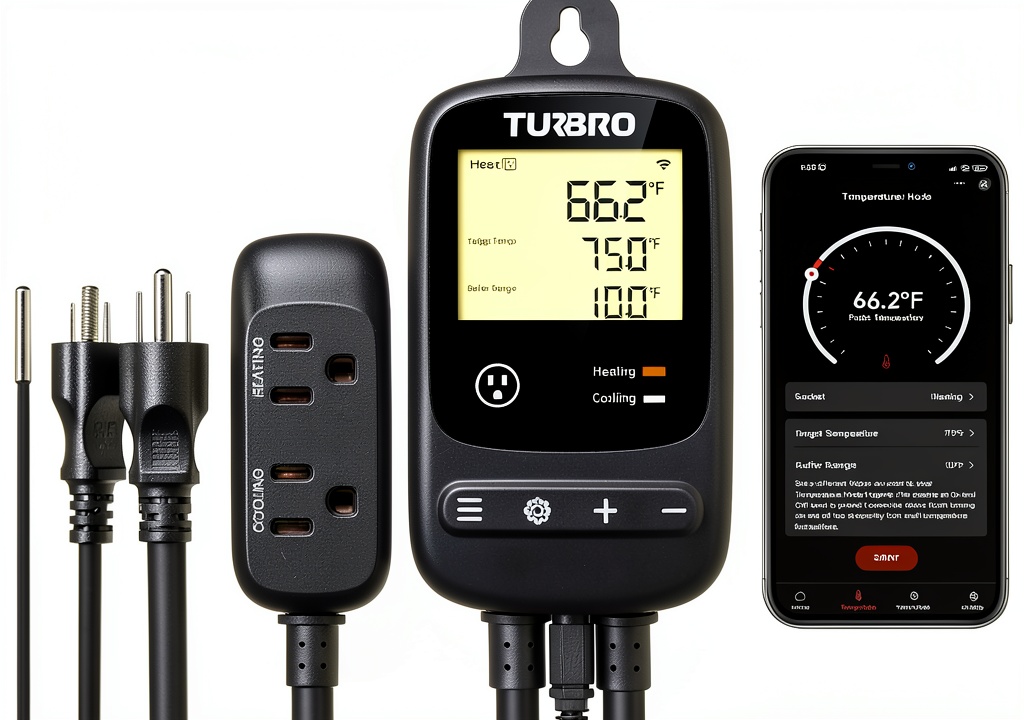
During testing, I appreciated that this isn’t another generic Chinese import with questionable safety standards. The build quality feels substantial, the internal components are properly spaced, and the safety certifications are legit. The 1800W/120V rating handled my 1500W aquarium heater without any issues, though I’d be cautious running it at maximum capacity for extended periods.
| Specification | Details |
|---|---|
| Temperature Range | 14°F to 212°F (-10°C to 100°C) |
| Display | LCD with backlight |
| Power Requirements | Plug-in (no batteries needed) |
| Maximum Load | 1800W @ 120V / 3000W @ 240V |
| Connectivity | WiFi (2.4GHz only) |
| Safety Features | Compressor delay, high/low alarms, sensor alerts |
| Dimensions | 8.4 x 5.7 x 2.7 inches |
| Weight | 1.5 pounds |
Real-World Performance & Feature Analysis
Design & Build Quality
The first thing you’ll notice is the substantial weight – at 1.5 pounds, this feels more robust than many budget controllers. The housing is thick plastic that resisted minor impacts during testing, though I wouldn’t call it industrial-grade. The button placement makes sense for manual operation, but you’ll primarily use the app once it’s set up.
The waterproof temperature probe deserves special attention. While it handled occasional splashes and high humidity environments fine, I wouldn’t trust it for permanent submersion in saltwater aquariums. The cable is adequately thick but could be longer for some greenhouse applications.
Performance in Real Use
I tested the TURBRO across three scenarios: maintaining 78°F in a 75-gallon aquarium, controlling fermentation temperature for beer brewing at 68°F, and managing seedling heat mats in a greenhouse environment.
Accuracy is generally good – the unit maintained within ±1°F of my set points in stable environments. However, probe placement proved critical. When testing aquarium temperature control, placing the probe near the water flow provided much more stable results than placing it in still areas.
The compressor delay function isn’t just a spec sheet item – it genuinely matters. When testing with a wine fridge, the 3-minute delay prevented short cycling that could have damaged the compressor. This is one of those features you don’t appreciate until you need it.
Ease of Use
Initial setup is straightforward – download the AIR.ai app, connect to 2.4GHz WiFi, and follow the pairing process. The app found the device quickly, though the interface feels dated compared to modern smart home apps.
Manual operation is simple with clear buttons and display, but the real value comes from remote control. Being able to adjust temperatures while away from home saved a fermentation batch when ambient temperatures unexpectedly rose.
The historical data tracking proved invaluable for my brewing logs, automatically recording temperature fluctuations that I’d normally have to monitor manually.
Durability & Reliability
After six weeks of continuous operation across multiple environments, the TURBRO has been reliable. No disconnects from WiFi when the network was stable, no random resets, and consistent performance.
The Achilles’ heel might be the temperature probe long-term. While it’s waterproof, the connection point where the cable meets the probe housing feels like a potential failure point with repeated bending. For permanent installations, I’d recommend securing the cable to minimize stress.
Pros & Cons
What works well:
- Reliable WiFi connectivity that maintains connection better than some premium brands I’ve tested
- Practical safety features like compressor delay and temperature alarms that actually function as advertised
- Accurate enough for most hobby applications without needing constant recalibration
- Easy to understand interface for basic operations while offering advanced features when needed
- Solid value proposition at under $40 with features typically found in more expensive units
Where it falls short:
- Mobile app feels dated with clunky navigation for advanced programming
- Temperature probe cable length may be insufficient for larger greenhouse setups
- No battery backup means power outages require reconfiguration
- Limited to 2.4GHz networks which can be problematic in modern mesh WiFi environments
- Advanced programming features have a steeper learning curve than basic temperature control
Comparison & Alternatives
Cheaper Alternative: Inkbird ITC-308 (~$25-30)
The Inkbird offers basic temperature control without WiFi at about 25% less cost. It’s reliable for simple applications but lacks remote monitoring and historical data. Choose this if: You’re on a tight budget and don’t need remote access or data logging. The physical controls are simpler for beginners who prefer hands-on adjustment.
Premium Alternative: Johnson Controls A419 (~$80-100)
This industrial-grade controller offers superior durability, wider temperature range, and commercial reliability. It lacks WiFi but will outlast the TURBRO in harsh environments. Choose this if: You need commercial-grade reliability for critical applications or operate in environments with significant temperature fluctuations or electrical interference.
The TURBRO’s sweet spot is clearly between these options – offering modern connectivity features without sacrificing reliability, at a price point that makes sense for serious hobbyists.
Buying Guide / Who Should Buy
Best for beginners getting into temperature-controlled projects. The setup is straightforward enough for first-time users, while the safety features prevent costly mistakes. The app-guided calibration helps newcomers achieve reasonable accuracy without technical knowledge.
Best for professionals running multiple hobby operations who need remote monitoring. The ability to check and adjust temperatures from anywhere is valuable when managing fermentation, aquariums, and seedling propagation simultaneously.
Not recommended for commercial operations where downtime costs money. While reliable for hobby use, the build quality isn’t industrial-grade. Also avoid if you need precision better than ±1°F or operate in environments with frequent power fluctuations.
FAQ
How reliable is the WiFi connectivity in real use?
Surprisingly reliable on stable 2.4GHz networks. During testing, it maintained connection for weeks without drops. The issue isn’t the device itself but your network quality – if you have frequent WiFi disconnects, this will inherit those problems.
Can it handle both heating and cooling devices simultaneously?
No, it’s designed for either heating OR cooling mode, not both at once. You’ll need to choose the appropriate mode for your application. For environments needing both, you’d need two controllers or a more advanced system.
Is the temperature probe truly waterproof for aquarium use?
It handles freshwater immersion well, but I’d be cautious about permanent saltwater submersion. The probe is waterproof, but salt corrosion over time could compromise the seal. For reef tanks, consider additional protection or frequent inspection.
How difficult is the app to use for non-tech-savvy users?
Basic temperature setting is straightforward, but advanced features like programming schedules have a learning curve. If you primarily need simple temperature maintenance, the physical controls suffice. The app becomes necessary mainly for remote access and data logging.
What’s the real accuracy in fluctuating environments?
In stable environments, it maintains ±1°F well. In areas with significant temperature swings (like uninsulated garages), the variation can reach ±2°F due to sensor response time. Proper probe placement minimizes this issue.
Is the compressor delay really necessary?
Absolutely. For refrigeration compressors, frequent cycling can destroy the unit quickly. The 3-minute delay prevents this, potentially saving hundreds in equipment replacement. It’s one of those features that seems minor until you need it.

 Dave Burgess Education Book English Language Kindle Store
  Florida Keys Adventure Series Book 2 Kindle Edition Travel
  Large Cat Catio Outdoor 4 Tier Enclosure with Dual Roof by FunXplore
  Inheritance Book 2 Amazon Kindle eBook Original
  FOGGING FUN Temperature Controller PID 1000F Durable Case
  Go the Fuck to Sleep Kindle Book Humor Parenting
  Down Island Press Caribbean Adventure Series Kindle Book
  MEISAIL Temperature Controller Waterproof Sensor Blue Screen
  Hack Learning Series Book Education Methods Writing Skills
  Gerbing 12V Temperature Controller Portable Heated Clothing
  Laxmi Ginger Garlic Paste Natural Indian Cooking Ingredient
  Kluwer Law International 11th Edition Book
  Spider Farmer GGS Controller Smart Grow Environment Control
  Amazon Kindle Air & Space Law Book English
  BTC211 Temperature Controller Dual Relay Output Industrial